The Engineering Challenge Hidden Inside Extra-Wide Planks
Extra-wide planks over five inches demand multi-layered engineered construction to resist expansion and contraction across seasonal humidity shifts. Solid wood movement increases with width, raising cupping and gapping risks, while engineered cores stabilize the structure beneath a real wood veneer, making wide formats viable for underfloor heating and large open-plan interiors.
Key Takeaways
- Extra-wide planks over 210mm showcase natural wood beauty better than standard 2-3 inch boards
- Extra-wide engineered planks are available in 240mm and 260mm widths for luxury residential projects
- Engineered wide plank flooring performs reliably in multi-unit apartments and high-rise developments
What Counts As Wide Plank Flooring?
Wide plank flooring describes boards wider than 5 inches, a step up from the standard 2-3 inch strip boards found in many older homes. Width alone changes the character of a room, drawing attention to grain patterns and reducing the number of seams underfoot. Beyond that basic threshold, though, definitions start to blur depending on the supplier.
Some manufacturers push the category further. Certain engineered wood ranges include planks measuring 240mm and 260mm, equivalent to roughly 9.5 and 10 inches respectively. These sit at the upper end of what most buyers would call wide, bridging the gap between a conventional strip floor and a statement-making plank.
Width comparison at a glance:
- Standard strip flooring: 2-3 inches
- Wide plank flooring: 5 inches and above
- Extra-wide engineered boards: 9.5-10 inches
How Does Board Width Affect Performance?
Wider boards tend to move more with changes in humidity and temperature than narrower strips, which puts greater emphasis on dimensional stability. Engineered constructions, built in layers rather than from a single piece of timber, generally manage this movement better than solid wood of equivalent width. That makes construction method, not just width, a deciding factor for renovators weighing up large-format floors.
Engineered wood is one of several flooring styles available to buyers, alongside herringbone, vinyl, and solid oak, each suited to different rooms and budgets. For luxury interiors specifically, wide-format options designed with this stability challenge in mind are widely available.

Why Does Width Affect Dimensional Stability?
Wider boards move more because each plank contains more wood fiber, and more fiber means more material reacting to moisture. Dimensional stability describes a floor's resistance to expansion and contraction as humidity and temperature shift through the year. Wide plank flooring magnifies this effect: a 10-inch board moves further in absolute terms than a 3-inch strip, even when species and moisture content are identical.
Seasonal climate is the real test. A core engineering question for anyone considering wide boards is whether the flooring holds up through changing conditions, particularly in homes that swing between damp autumns and dry, centrally heated winters.
Construction method determines how well a floor copes with that movement. Engineered wood uses layers of timber bonded with the grain running in alternating directions, giving it structural stability that solid hardwood struggles to match at wider widths. That layered build is why engineered boards hold their shape better than solid wood as plank width increases.
Does Engineered Wood Perform Better Than Solid Wood at Wide Widths?
Yes. The multi-layered structure spreads stress across several layers rather than concentrating it in one piece of solid timber. This design provides strength suited to high-traffic rooms like hallways and living rooms. Wide solid boards are more prone to gapping or cupping. Thicker engineered options also improve insulation, keeping rooms warmer and quieter while reinforcing the stability wide planks need.
| Factor | Solid Wood | Engineered Wood |
|---|---|---|
| Core structure | Single piece of timber | Layered, cross-grain construction |
| Movement with humidity | Greater at wide widths | Reduced by layering |
| Suitability for wide planks | Limited | Better supported |
Architects and renovators specifying luxury interiors should treat width and construction as linked decisions, not separate ones. The wrong pairing shortens how well a floor performs over its working life.

Engineered Or Solid: Which Wide Plank Wins?
Engineered construction wins for most luxury installations, while solid boards suit a narrower set of low-moisture settings. Performance, longevity, and compatibility with modern building systems carry as much weight as appearance in large residences, multi-unit apartments, and high-rise developments. Construction type, not surface finish, decides how well wide plank flooring holds up under daily use.
Solid hardwood planks expand and contract with humidity and temperature. Engineered wood, built from cross-layered plies beneath a hardwood veneer, resists that movement far better than a solid board of the same width. This layered structure gives engineered planks stronger dimensional stability, a quality that matters once board widths move well beyond the standard narrow strip format.
Architects and developers specifying premium wood flooring for high-rise or multi-unit schemes often favor engineered builds for their compatibility with underfloor heating. Concrete subfloors common in modern construction. Solid wide planks can still work in the right room, but only where moisture control and careful acclimatization stay consistent year-round.
Does engineered wood flooring work in commercial spaces?
Yes. Engineered wood flooring extends well beyond residential projects into heavy-footfall commercial settings such as shops, cafes, restaurants, and bars. The layered build handles frequent traffic without the expansion risk that solid wood carries in busy, climate-variable environments.
| Factor | Solid Wide Plank | Engineered Wide Plank |
|---|---|---|
| Moisture response | High movement | Minimal movement |
| Underfloor heating | Generally unsuitable | Compatible |
| Commercial footfall | Limited | Well-suited |
| Multi-unit/high-rise fit | Requires careful control | Stronger fit |
For architects and renovators weighing both options, the layered build of engineered boards delivers more dependable performance across shifting indoor climates, especially where generous widths amplify any seasonal movement.
What Installation Challenges Do Wide Planks Pose?
Wider boards demand more precision at every stage, from subfloor prep to the final row against the wall. Installers typically fit engineered wood using a tongue and groove method, locking each plank into the next. Some newer ranges rely on click systems instead. Either way, mistakes show up more visibly on a broad board than on a narrow one, so accuracy matters.
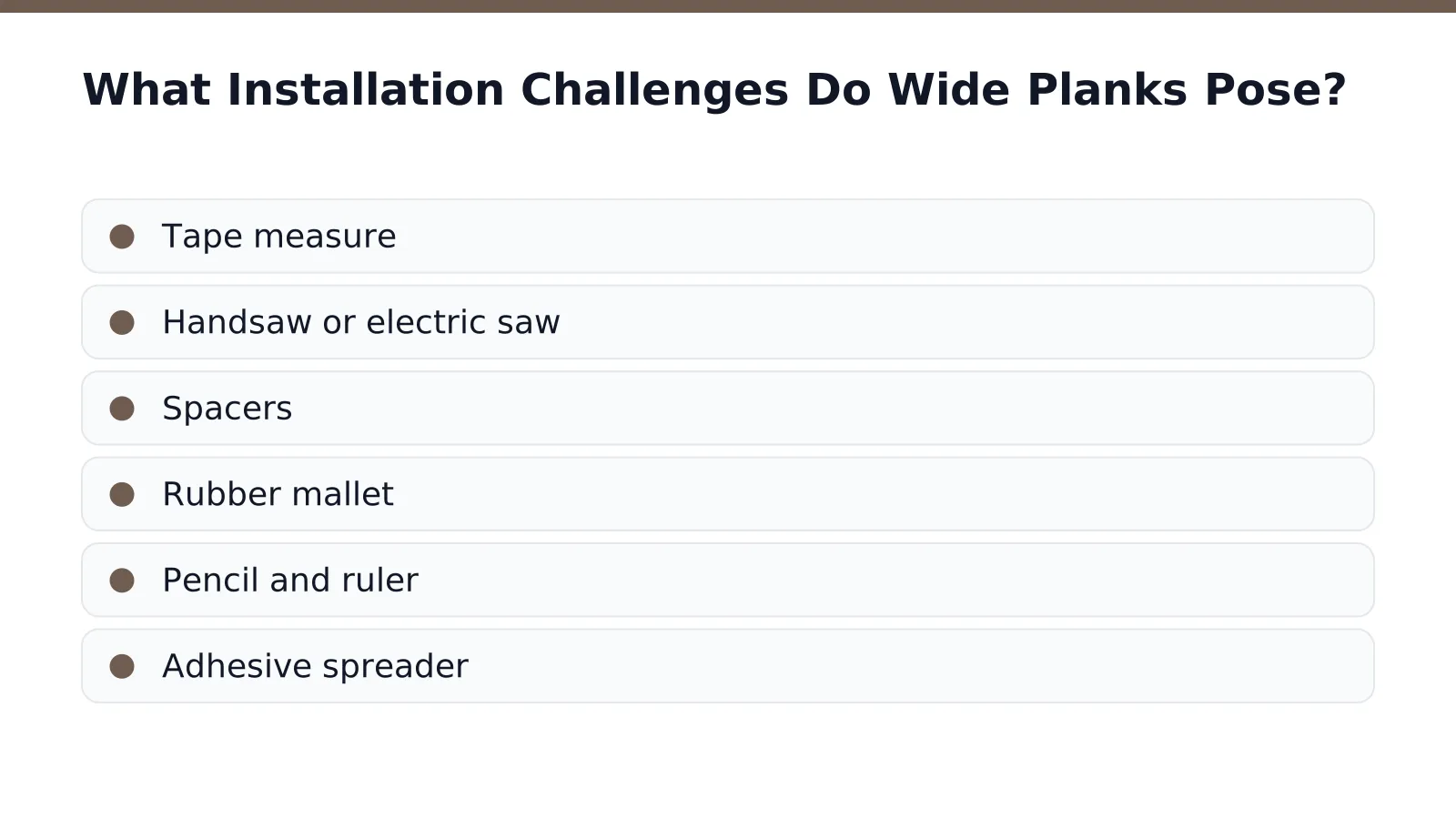
Getting the right tools together before starting makes a measurable difference to the finished result. A proper installation kit includes:
- Tape measure
- Handsaw or electric saw
- Spacers
- Rubber mallet
- Pencil and ruler
- Adhesive spreader
Spacers do more than keep rows neat. They maintain an expansion gap around the perimeter of the room, and that gap becomes more important as plank width increases. Wood moves with changes in humidity and temperature. A wider board shifts by a greater absolute amount than a narrow one, even at the same rate of movement. Skipping this step risks buckling or gaps opening up later.
Does underlay matter more with wide planks?
Underlay isn't optional on any engineered wood floor; it supports the structure and helps the planks sit evenly. With wider boards, uneven support becomes more noticeable, since each plank spans a larger section of subfloor. A consistent underlay layer reduces movement and creaking across that wider span.
Can wide planks be installed without professional help?
Careful measuring, cutting and spacing are manageable for confident DIYers using the right tools. Larger boards leave less room for error, though, so double-checking measurements before cutting pays off. Taking time over the expansion gap and underlay stages prevents most long-term problems.
Is Wide Plank Flooring Right For You?
Suitability hinges on three practical factors: the specific product chosen, the layout of the room, and the full installation budget. The width measurement printed on a box label means little on its own. A homeowner weighing wide plank flooring for a narrow hallway faces different risks than someone fitting an open-plan living area.
Budget matters just as much as aesthetics. Wider boards often cost more to install correctly, and skipping proper subfloor preparation invites long-term problems with gaps, cupping, or movement. Cutting corners here rarely saves money once repairs become necessary.
What Should Buyers Check Before Choosing A Wide Plank Floor?
Species, grade, surface texture, finish, and construction type all deserve attention alongside the board's dimensions. Engineered wood construction, for example, behaves differently from solid timber under temperature and humidity swings, directly affecting dimensional stability over time. Recording these details before purchase helps avoid mismatches between expectation and real-world performance.
A simple pre-purchase checklist helps:
- Confirm the wood species and grade
- Check surface texture and finish type
- Verify construction (engineered versus solid)
- Measure the room and note light exposure
- Calculate total installation cost, not just material price
Who Can Answer Specific Suitability Questions?
Anyone uncertain about a particular property can speak with a flooring advisor directly for guidance before committing to an order.
FAQ
What qualifies as wide plank flooring?
Wide plank flooring includes boards wider than 5 inches, a step up from standard 2-3 inch strip boards. Some engineered ranges extend further, offering planks at 240mm and 260mm for a statement-making look.
Why do wider planks move more than narrower boards?
Wider boards contain more wood fiber, so more material reacts to humidity and temperature shifts. This means a 10-inch board moves further in absolute terms than a 3-inch strip, even with identical species and moisture content.
Is engineered wood better than solid wood for wide planks?
Engineered wood uses layers of timber bonded with alternating grain directions, giving it structural stability that solid hardwood struggles to match at wider widths. This layered build helps engineered boards hold their shape better as plank width increases.
Conclusion
In closing, extra-wide planks demand careful attention to substrate preparation, acclimation, and installation technique to perform reliably. Moisture management remains the critical factor determining whether engineered wood at wider dimensions will remain stable or develop gaps and cupping. Selecting appropriate plank thickness, veneer quality, and core construction for your specific environment, combined with proper installation by experienced professionals, transforms the engineering challenge into a practical advantage that delivers both aesthetic impact and lasting durability.


About The Author