The Hidden Lifecycle of a Floor: From Forest or Factory to Landfill
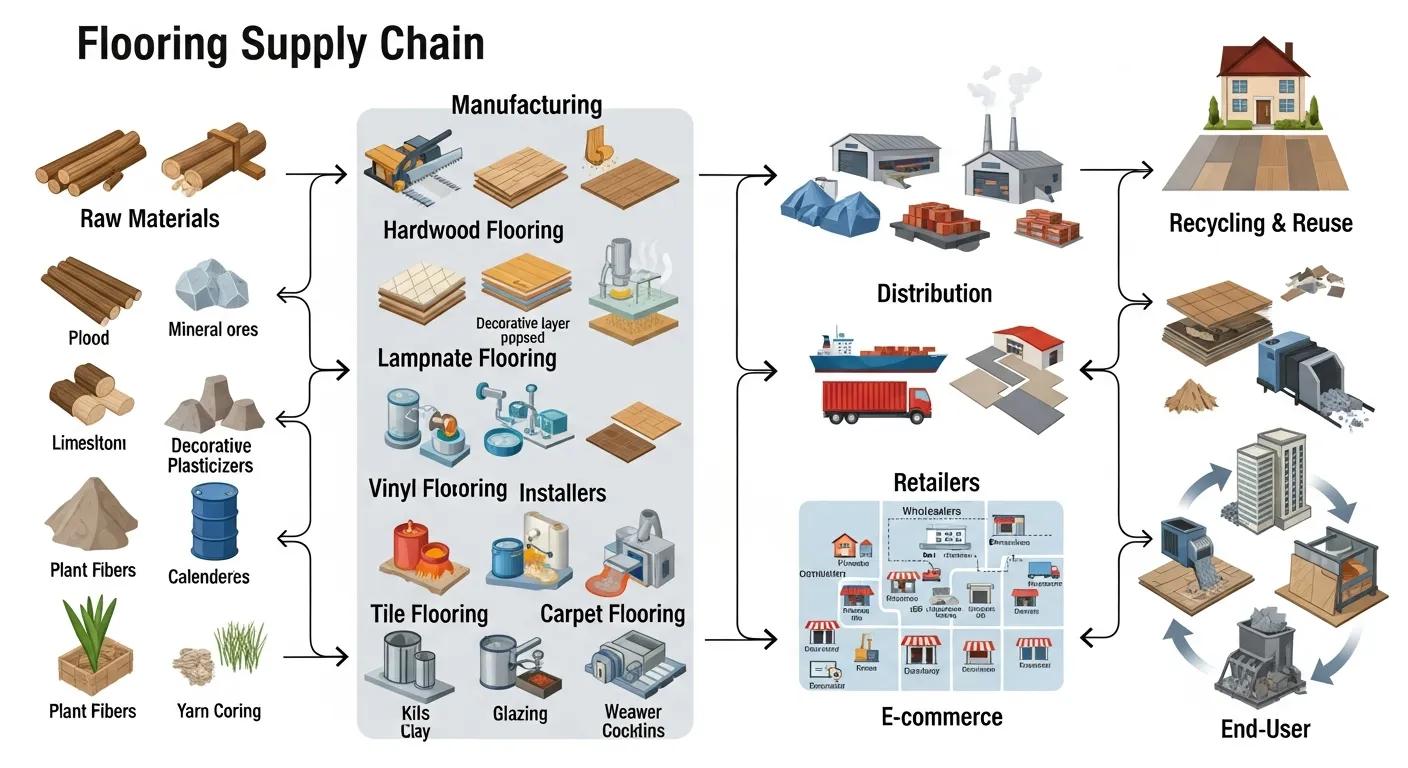
Flooring follows a long — and often invisible — journey: starting with raw resources in forests or factories, moving through production and installation, and finishing with reuse, recycling or disposal. This guide walks through each stage, explains what determines a floor’s useful life, and outlines practical end‑of‑life choices. A clearer view of the supply chain and lifecycle impacts helps homeowners and specifiers choose floors that balance design, performance and sustainability, while recognising industry challenges such as emissions and waste management.
Assessing a floor’s sustainability means looking at several factors — environmental, economic and social — to understand its full lifecycle impacts.
Multi‑Criteria Life Cycle Assessment of Flooring Systems
This study applies a four‑step approach: first, a life cycle assessment (LCA) ranks flooring systems by carbon dioxide (CO2) emissions and potential effects on the ozone layer. Second, a life cycle cost assessment (LCCA) compares the alternatives on cost across their lifetime. Both LCA and LCCA cover production and construction, transport, maintenance and end‑of‑life. Third, a social life cycle assessment (SLCA) looks at impacts on workers, local communities, wider society and consumers. Finally, a multi‑criteria decision‑making (MCDM) method brings those results together to recommend the most sustainable flooring option based on the combined set of criteria.
Applying three pillar indicator assessments on alternative floor systems: life cycle study, D Yeoh, 2021
Key stages in the flooring manufacturing process
Making finished flooring involves sourcing raw inputs, manufacturing components, and distributing products to retailers and installers. Each step carries an environmental footprint; mapping the flow — raw materials, processing, transport, installation and maintenance — reveals where changes can reduce impacts.
How raw materials are sourced for flooring
Materials vary by product: hardwood typically comes from managed forests, bamboo from plantations, and many resilient floors from petrochemical supply chains. Certifications such as FSC and PEFC are commonly used to verify responsible forestry and traceability. Certified sourcing helps protect ecosystems and supports local economies, making it a common requirement for greener specifications.
Environmental impacts during flooring production

Manufacturing can generate significant carbon emissions, use large volumes of water, and produce waste. Vinyl production raises particular concerns around dioxins and plasticizers during manufacture and disposal, while poorly managed wood supply can drive deforestation. To lower impacts, manufacturers are increasingly adopting recycled inputs, cleaner production processes and water‑saving measures.
Life cycle assessments remain the primary tool for comparing the environmental performance of different flooring types — from production emissions to end‑of‑life outcomes.
Vinyl Flooring LCA: Environmental Impacts & Waste Disposal
This case study assesses emissions linked to additives in cushion vinyl floor coverings across the full cradle‑to‑grave chain. For end‑of‑life cushion vinyl it models four disposal routes: incineration, controlled landfill, uncontrolled landfill (with potential DEHP release), and material recycling — demonstrating how environmental outcomes change depending on the chosen path.
LCA Case Study Cushion Vinyl Floor Covering and DEHP: Environmental Impacts of Use and Recycling of Additives (DEHP) in
Products, L van Oers, 2012
How long flooring lasts — and what affects its lifespan
How long a floor lasts depends on the material, the quality of installation and ongoing maintenance. Knowing what shortens or extends a floor’s life helps buyers match product choice to the intended use and avoid premature replacement.
Factors that influence product lifespan
The main drivers are material quality, installation technique and the building environment. A well‑made hardwood floor can easily last 50+ years with proper care; lower‑grade options may need replacing within a decade. Large swings in humidity, temperature extremes and heavy foot traffic accelerate wear.
Best practices for flooring maintenance
Simple, regular care extends service life. Recommended steps:
- Regular cleaning: Sweep or vacuum to remove grit that abrades surfaces.
- Moisture control: Use entrance mats and avoid standing water to prevent swelling and warping.
- Periodic refinishing: Refinish solid hardwood every 7–10 years to restore and protect the surface.
These routine actions maintain function and appearance, save money over time and reduce waste from premature replacement.
End of life: recycling and disposal options for flooring
Disposing of flooring responsibly reduces environmental harm. The main routes are reuse, recycling and energy recovery — choosing the right option keeps materials circulating and reduces landfill demand.
How flooring can be recycled or disposed of responsibly
Practical options include donating reusable materials, taking components to specialised recycling centres, or using controlled waste‑to‑energy where appropriate. Some products — such as carpet tiles and reclaimed wood — can be refurbished or repurposed. Availability varies by region, so check local services and manufacturer take‑back schemes.
Designing products for reuse and longer life — the circular approach — is a central strategy for cutting waste across the flooring sector.
Circular Economy & Sustainable Flooring Business Models
The circular economy encourages production and consumption patterns that keep materials in use after their initial life. Prioritising reuse, refurbishment and downcycling reduces waste, conserves resources and extends material lifespans — key aims for sustainable flooring business models.
Sustainability in flooring: assessing the environmental and economic impacts of circular business models, P Krassnitzer, 2025
Certifications that support sustainable end‑of‑life practices
Certifications make it easier to spot products with stronger environmental and end‑of‑life credentials. Look for standards such as FSC, PEFC and EPDs, plus other regionally recognised labels that include waste and recycling criteria; these indicate a product has been evaluated for sourcing, production and disposal pathways.
Available sustainable flooring materials and how they compare

More eco‑conscious flooring options are now available. Each material involves trade‑offs between durability, maintenance and environmental impact; understanding those trade‑offs helps you pick the best fit for a given space.
Benefits of wood, bamboo, vinyl and engineered flooring
Common choices and their main strengths:
- Wood flooring: Timeless and durable — with care, solid hardwood can last 50+ years.
- Bamboo flooring: Fast‑growing and renewable; visually similar to hardwood and typically lasts 20–25 years.
- Vinyl flooring: Cost‑effective, water‑resistant and low maintenance; typical life expectancy is 10–20 years.
- Engineered wood flooring: Real wood veneer over a stable core — better dimensional stability and generally lasts 25–40 years.
These options let buyers weigh appearance, lifespan and environmental priorities to find the right balance.
How certifications and supply chain transparency shape choices
Certifications and clear supply chain information help consumers and specifiers make informed choices. An FSC or PEFC label verifies sustainable wood sourcing, while credits from schemes such as BREEAM or LEED reflect wider environmental performance. Transparency shows where materials come from and how they’re processed.
| Flooring Material | Sustainability Rating | Lifespan | Maintenance Level |
|---|---|---|---|
| Wood Flooring | High | 50+ years | Moderate |
| Bamboo Flooring | Very High | 20-25 years | Low |
| Vinyl Flooring | Low to Moderate | 10-20 years | Low |
| Engineered Wood | High | 25-40 years | Moderate |
This table gives a quick comparison of sustainability ratings, typical lifespans and maintenance needs to help you weigh options at a glance.
Frequently Asked Questions
What are the environmental benefits of using sustainable flooring materials?
Choosing sustainable flooring — for example reclaimed wood or responsibly harvested bamboo — eases pressure on forests and often carries a lower carbon footprint than some conventional materials. These choices support recycling and biodegradability routes that help close material loops and reduce landfill waste.
How can consumers identify eco‑friendly flooring options?
Look for trusted marks such as FSC, PEFC and published EPDs, review manufacturer transparency on sourcing and production, and check for product take‑back or recycling programmes. Product data sheets and independent reviews are useful verifications.
What role does flooring installation play in sustainability?
Installation affects both waste and longevity. Correct installation reduces off‑cuts and failures; selecting low‑VOC adhesives and efficient techniques lowers environmental and health impacts. Using an experienced installer reduces the risk of early replacement.
Are there any financial incentives for choosing sustainable flooring?
Depending on where you are, tax credits, rebates or grants may be available for eco‑friendly materials or energy‑efficient upgrades. Longer product life and lower maintenance can also give lifecycle savings that offset higher up‑front costs.
What are the challenges in recycling flooring materials?
Recycling is often complicated by mixed materials, adhesives and chemical additives. Vinyls and composite products frequently need specialised processes that many local authorities don’t provide. Better collection infrastructure and clearer labelling would improve recycling rates.
How does consumer demand influence the flooring supply chain?
Growing demand for greener products encourages manufacturers to source more responsibly, cut waste and improve transparency. That market pressure drives innovation in materials, production methods and business models toward greater sustainability.
The Hidden Lifecycle of a Floor
Knowing how flooring is made, used and disposed of helps you make smarter choices — for performance, cost and the environment. Choose durable, certified products, follow straightforward maintenance routines, and explore reuse or recycling when a floor reaches its end of life. Small decisions add up and can nudge the flooring industry toward a more sustainable future.


About The Author