The Hidden Language of Floor Plans: How Flooring Dictates Furniture Layout Without Permission

Flooring isn’t just something underfoot — it quietly tells us how a room should work. Material, pattern, plank direction and colour all shape how we place furniture, how people circulate and the overall mood of a space. This article breaks down how floors influence layout through rhythm, scale, contrast and tactile cues, and gives practical ways to use those forces so your floor helps — not fights — your furniture plan. You’ll find clear pairing rules for common materials, pattern-aware placement tips, guidance on tone and texture, zoning tactics for open plans, and technical points like durability, acoustics and sustainability. Each section mixes design thinking with hands-on rules and visualisation tips so you can trial ideas before committing to costly installs. By the end, you’ll be able to ‘read’ a floor plan and use flooring deliberately to shape layout, circulation and atmosphere.
Flooring Types & Furniture Pairing: Which Materials Support Different Styles?
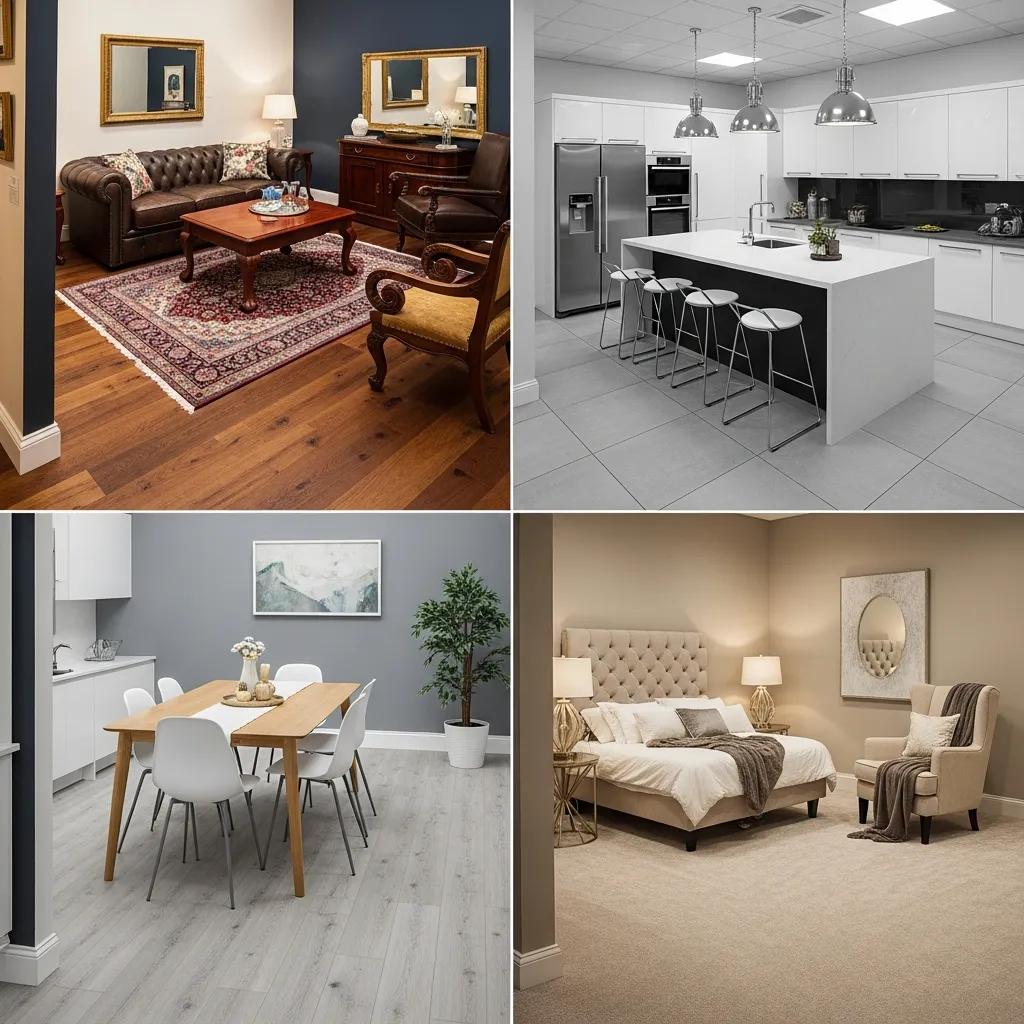
Every flooring material carries a visual message — grain, sheen, join rhythm and tone — that can either complement or compete with your furniture. Solid wood brings warmth and formality and often encourages furniture to sit along the boards’ long axis to support flow. Laminate copies that look with a more consistent repeat and lower tolerance for concentrated loads, so consider furniture feet and protection. Tile and vinyl add module and grout lines that can order a room or clash with busy upholstery; carpets and rugs soften sound and anchor seating, giving you more freedom to float furniture without exposing small misalignments.
Used thoughtfully, the mix of flooring and furniture materials defines both character and function in a room.
Interior Materials — Flooring & Furniture: Usage Notes
Different materials are chosen for floors, furniture and wall linings depending on the space and its use. Material choice shapes durability, comfort and appearance across many building types.
THE INTERIOR IN SCHOOL BUILDINGS — MATERIALS OF ENCLOSING STRUCTURES AND FURNITURE IN SPACE, 2017
Below is a quick reference that summarises key attributes and pairing rules to help you choose.
| Flooring type | Key characteristics | Best-matching furniture styles |
|---|---|---|
| Hardwood | Visible grain, warm tones, durable finishes | Traditional, Scandinavian, mid-century modern |
| Laminate | Uniform repeat, cost-effective, scratch-resistant options | Contemporary, budget-conscious modern, rental-friendly pieces |
| Vinyl | Wide pattern range, moisture-resistant, low profile | Modern, transitional, kitchens and utility rooms |
| Tile | Hard, patterned, grout lines define modules | Mediterranean, minimalist modern, heavy-traffic dining areas |
| Carpet / Area rugs | Soft texture, acoustic damping, shape and colour variety | Cosy, eclectic, layered living and bedroom schemes |
Knowing these behaviour traits helps you match furniture to the floor instead of forcing a clash. Next, we contrast hardwood and laminate to show how small differences change layout choices.
Hardwood vs Laminate: Which pairs best with modern or traditional furniture?
Hardwood reads as authentic because of its grain variation and subtle tone shifts — a natural partner for traditional and mid-century pieces that rely on material warmth. Modern furniture also benefits from wide, matte planks that create a calm backdrop for sculptural items. Laminate gives a steadier, often glossier repeat; that predictability suits minimalist, contemporary furniture where a neutral canvas enhances geometric silhouettes. Because laminate can dent under heavy, concentrated loads, use protective pads under legs and favour lighter or metal-framed pieces when possible.
In short: hardwood highlights material richness and variation; laminate offers a clean, low-maintenance stage for pared-back furniture.
Tile & Vinyl: Pairing patterns with furniture aesthetics
Tiles and patterned vinyl create a visible grid or repeat that can dominate smaller rooms if not considered alongside furniture geometry. Large-format tiles with narrow grout visually expand a space and allow for bolder furniture choices; small tiles add rhythm that can clash with busy upholstery. Vinyl’s versatility lets you contrast boldly — patterned vinyl beside plain, textured furniture works well — but strong repeats usually call for simplified seating and fewer surface patterns. When floors are busy, centre key furniture on tile modules or use rugs under seating to calm the visual field and create clear focal areas.
Either align furniture to the grid or deliberately break it with a rug — both are reliable ways to keep the room visually balanced.
Ready to shop? Look for wood, laminate, vinyl, tile, carpet and area rugs from suppliers that offer clear product information, samples and visual mock-ups. Testing a sample with your furniture before buying is always worth the trouble.
- Pairing checklist: Check grain, sheen, wear resistance and upkeep before you buy.
- Installation checklist: Think about plank direction and tile orientation relative to primary sightlines.
- Practical tip: Test a 1m² sample with the furniture you plan to use to judge scale and contrast.
Flooring Patterns and Their Layout Impact: From Herringbone to Grid
Floor patterns create directional cues and visual rhythm that shape sightlines, focal points and the natural axes where furniture wants to sit. Angled patterns like herringbone or chevron introduce movement and pull the eye to an apex — perfect for leading attention to a fireplace or entrance. Linear grids and rectilinear tiles read formal and ordered, nudging furniture to align parallel to the pattern. Mixed-width planks feel more organic and can subtly delineate zones; the scale, repeat and contrast with the walls determine whether furniture aligns or floats independently of the floor.
Use these pattern behaviours to decide whether the floor should be a strong director of placement or a neutral stage for varied layouts. Quick reference below.
| Pattern | Visual effect | Furniture-placement recommendation |
|---|---|---|
| Herringbone | Dynamic diagonal flow, central emphasis | Anchor seating at the pattern convergence; align sofas perpendicular to the apex for balance |
| Chevron | Directional thrust toward a focal point | Use to lead the eye to an entry or hearth; central coffee tables work well |
| Grid (tiles/planks) | Formal, orthogonal rhythm | Pair with rectilinear furniture aligned to joints for a cohesive look |
| Mixed-width planks | Organic, staggered rhythm | Anchor seating with layered rugs to create relaxed islands |
| Diagonal planking | Visually widens or lengthens a room | Place long sofas parallel to the diagonal to accentuate the effect |
These simple rules let you work with directional pull instead of fighting it. The next sections give practical alignment scenarios for angled and linear patterns.
Herringbone & Chevron: How angled patterns guide furniture placement
Herringbone and chevron form strong V-shaped repeats that naturally draw attention to their apex. Those points make good locations for focal furniture — a statement sofa, console or feature chair. When a room has an angled pattern, position primary seating so its back runs parallel or intentionally perpendicular to the dominant axis to avoid visual tension. In small rooms, centre a rug at the V apex to stabilise the pattern; in larger spaces, let the pattern lead toward architectural features and align dining tables along the line of movement. Careful alignment turns angled patterns from a challenge into a clear wayfinding advantage.
These tactics make pattern-led rooms feel organised and purposeful.
Grid & Mixed-width Planks: Defining zones without walls
Grids and mixed-width planks take different approaches to zoning. A grid pushes modular order that suits formal, aligned furniture groups; mixed-width planks create a looser field perfect for organic zones and layered rugs. Use grid lines to position large pieces like dining tables and media units so joints look deliberate. For mixed-width floors, add area rugs under seating to form distinct islands without harsh transitions, and orient rugs to emphasise the planks’ stagger. Both strategies let you define living and dining areas in an open plan without physical partitions.
Picking the right pattern strategy makes zoning feel natural and unobtrusive.
Spatial Perception and Floor Colour: How Colour and Texture Change Room Feel
Floor colour and surface texture change how big, deep or intimate a room feels and affect the contrast you need between furniture and floor. Light floors reflect more light, visually enlarging a space and offering a neutral canvas for low-contrast, minimalist palettes. Dark floors absorb light and add depth and cosiness — they usually benefit from lighter upholstery and careful rug placement to avoid visual heaviness. Texture and finish — matte versus gloss, smooth versus wire-brushed — also shift formality and perceived scale: glossy, fine-grain floors read more refined and compact, while textured matt planks feel tactile and suit layered, tactile furniture.
Research shows that materials and textures in interior spaces strongly affect spatial perception.
How Material & Texture Influence Spatial Perception
The size, shape, colours, materials and textures of an indoor space significantly influence how spacious it feels at different scales.
Effect of wall texture on perceptual spaciousness of indoor space, 2020
Use tone and texture deliberately to tune proportions and decide how much contrast or blending you want between furniture and floor.
Colour, Area & Height: Impact on Space Perception
Colour, area and height all visually convey spatial properties. This study found significant links between these variables and how people perceive space.
Effects of colour, area, and height on space perception, N Savavibool, 2017
- Colour rules: Light floors enlarge; mid-tones balance; dark floors add depth.
- Texture rules: Matt textures hide imperfections and pair well with tactile furniture; glossy finishes read more formal and reflect light.
- Contrast tips: Use rugs and cushions to introduce deliberate contrast on very light or very dark floors.
Light-coloured floors: Making spaces feel larger
Light floors bounce light and blur the boundary between walls and floor, making circulation paths clearer and rooms feel more open. Pair pale floors with low-contrast furniture — creams, pastels or pale woods — and favour slim furniture profiles so sightlines stay open. Glass or metal legs help preserve airiness; slightly darker rugs can anchor seating without breaking the flow. Avoid heavy, busy upholstery that competes with the space-expanding effect; introduce interest through soft textures and layered rugs instead.
Follow these guidelines and pale floors will enhance space rather than emphasise clutter.
Dark floors: Adding depth and cosiness
Dark floors ground a room and add intimacy, ideal for lounges, formal dining rooms and bedrooms when balanced with lighter furniture and generous lighting. Counterbalance dark floors with pale or mid-tone upholstery and well-placed rugs so the floor reads as a stage rather than an undifferentiated surface. Reflective ceilings or light wall finishes can lift the plane visually. Warm materials — leather, wool and timber with warm stains — harmonise especially well with dark floors.
With the right contrast and lighting strategy, dark floors deliver atmosphere without shrinking perceived space.
Open-Plan Living: Defining Zones with Flooring and Rugs
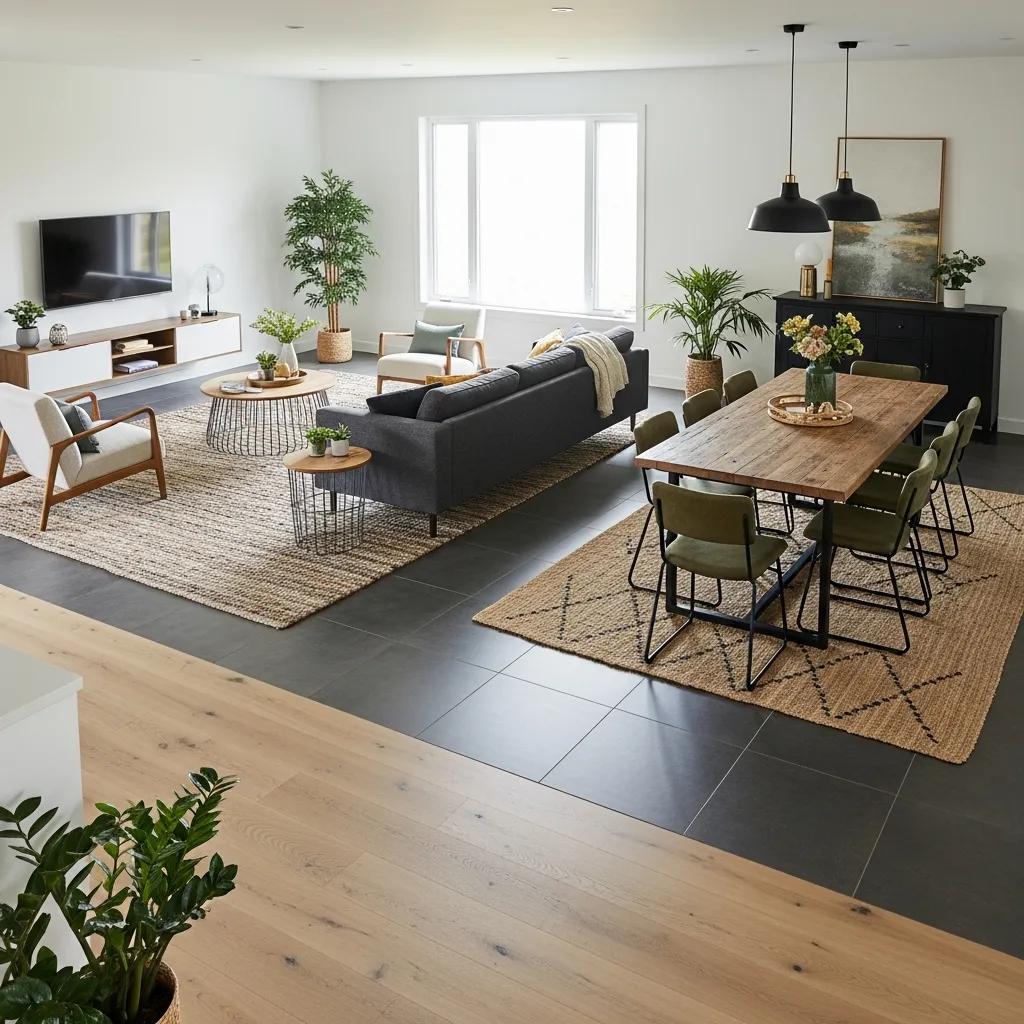
In open-plan layouts, flooring choices are one of the simplest ways to create clear functional zones while keeping visual continuity and good circulation. Material changes — for example wood to tile at a kitchen threshold — mark durable boundaries for different activities. Directional planks or mixed-width transitions can quietly suggest separate living and dining areas. Area rugs are the most flexible zoning tool: they anchor seating groups, absorb noise and let you place furniture independently of the wider floor pattern. Transition strips and subtle changes in plank direction signal intention so flooring changes feel considered rather than abrupt.
Follow these step-by-step zoning techniques for most open-plan schemes.
- Map primary circulation routes first, then place zones so they do not block walkways.
- Use material changes or plank direction to delineate kitchen, dining and living areas.
- Anchor each seating group with a rug sized so the front legs of major furniture sit on it to form a cohesive cluster.
- Use transition strips or change plank direction to mark thresholds without visual jarring.
- Scale furniture and place it so each zone reads as an intentional space rather than leftover floor.
These steps make zoning repeatable and predictable. The next sections cover precise rug-sizing rules and common mistakes to avoid.
Practical product tips: choose area rugs sized to seating groups, discreet transition strips for thresholds, mixed-width planks for softer zoning effects, and durable vinyl in high-use, spill-prone areas. Work with suppliers who offer samples and clear product info so you can compare options before committing.
This bridges design intent with realistic sourcing choices that solve typical open-plan problems.
Area Rugs & Flooring Transitions: Creating furniture zones
Rugs visually contain furniture and keep scale readable. The most reliable rule is to have the rug extend under the front legs of sofas and chairs, or be large enough for all furniture to sit fully on it in bigger arrangements. Rectangular rugs suit long sofas and coffee tables; round rugs work beneath round dining tables or single-seat clusters. Layering rugs helps control pattern and add texture when the floor pattern is busy. Transition strips should follow natural movement paths and be finished to complement the flooring so they feel like a design choice, not an afterthought. Correct rug size and placement turn a continuous floor into clear, comfortable furniture zones.
These measures make furniture feel anchored and intentional in open-plan rooms.
Avoiding common open-plan mistakes with flooring
Overloading a space with competing patterns or abrupt material contrasts fragments visual flow and makes furniture look disjointed. Pick one dominant floor pattern and introduce variation with rugs or subtle transitions. Undersized rugs are another common error — always err slightly larger within the room’s limits so seating reads as a group. Poorly placed transitions across main circulation routes can create trip hazards and force awkward furniture orientations, so align thresholds with natural movement and avoid cutting furniture legs across joins. Easy fixes include resizing rugs, switching to mixed-width planks for gentler zoning, or adding a runner to clarify pathways.
Dealing with these issues early keeps the space safe and visually cohesive, and sets you up for the technical considerations that follow.
Practical Considerations: Durability, Acoustics & Sustainability in Floor-driven Layouts
Technical attributes — scratch resistance, acoustic damping and material provenance — affect both your floor choice and how you place furniture to protect it. High-traffic seating areas and heavy furniture clusters need floors with strong wear ratings; softer, easily-marked floors require pads and rugs. Acoustics matter in multi-storey homes and flats — sound-transmitting floors may need underlay or carpeted zones beneath furniture to limit impact noise. Sustainable options like cork, bamboo or reclaimed wood have distinct textures and tones that influence furniture colour choices and may require different maintenance or moisture considerations.
| Product type | Attributes (durability / acoustics / sustainability) | Recommended use cases |
|---|---|---|
| Durable vinyl | High scratch and moisture resistance / Moderate acoustic damping / Often recyclable options | Kitchens, family rooms, dining areas with heavy use |
| Hardwood | Good durability with the right finish / Low acoustic damping unless underlaid / Can be reclaimed for sustainability | Living rooms, formal dining, areas where warmth and longevity matter |
| Laminate | Moderate durability depending on wear layer / Low acoustic damping unless underlaid / Less sustainable if not certified | Rental properties, budget refurbishments, low-traffic rooms |
| Cork / Bamboo | Moderate durability / Excellent acoustic damping / High sustainability when certified | Home offices, bedrooms, spaces prioritising eco credentials and comfort |
| Carpet / Area rugs | Variable durability / Excellent acoustic damping / Recyclability varies by material | Bedrooms, media rooms, seating clusters needing noise control |
Durable flooring for high-traffic furniture areas
Choose floors with robust wear layers and scratch resistance for entryways, living rooms and dining areas with moving chairs — durable vinyl and sealed hardwood are common choices. Protect floors with wide furniture feet, felt pads under legs and rotating rugs under dining chairs to reduce localised wear. For very heavy pieces, distribute weight with plywood underlay or discreet coasters to avoid plank compression. Regular maintenance — clear debris, wipe spills promptly and reseal protective finishes as recommended — keeps floors and nearby furniture in good condition.
These strategies prolong floor life and reduce the need to rearrange furniture because of wear.
Acoustic & sustainability considerations and their impact on furniture layout
Acoustic underlays, dense carpets and cork reduce airborne and impact noise, letting you place furniture without amplifying footsteps or bumps. Rooms with poor acoustics often benefit from larger rugs and more soft furnishings. Sustainable choices such as reclaimed wood or rapidly renewable bamboo tend to favour matt, natural stains and pair well with tactile materials like wool, linen and untreated timber. They may carry higher upfront costs or require specific care, so plan furniture placement to minimise moisture exposure and allow for maintenance routines. Address acoustics and sustainability early and your furniture layout will support comfort and environmental goals.
- Maintenance checklist: Sweep regularly, use pads under furniture, reseal hardwood as recommended.
- Acoustic checklist: Add underlay where impact noise matters; increase soft furnishings in echo-prone rooms.
- Sustainability checklist: Choose certified reclaimed or rapidly renewable materials and low-VOC finishes.


About The Author